



Nutrition Labelling and Claims
Health Canada has updated the Nutrition Facts table and List of Ingredients on packaged foods to make it easier for Canadians to understand and compare sugars content and make informed choices for healthy eating. As of January 1, 2026, front-of-package labels are required on most packaged foods that meet a threshold for saturated fat, total sugars, and/or sodium.
- Front-of-Package (FOP) Labelling for Foods High in Saturated Fat, Sugars, and/or Sodium. FOP symbols are now mandatory on most packaged foods and beverages that meet or exceed specific thresholds for saturated fat, total sugars, and/or sodium.
- Sugars in the Nutrition Facts table. The Nutrition Facts table lists the amount of total carbohydrate, including total sugars in a stated serving size. A Daily Value of 100 g is shown for total sugars.
- Sugars in the List of Ingredients. The ingredients list identifies all types of sugars and sweetening ingredients in the food or beverage in descending order of quantity. All sugars-based ingredients are grouped together in brackets.
- Sugars-Related Nutrient Content Claims. There are six nutrient content claims related to sugars permitted in Canada.
Front-of-Package Labelling for Foods High in Saturated Fat, Sugars, and/or Sodium
Health Canada has introduced new Front-of-Package (FOP) labels, which are mandatory as of January 1st, 2026 (1).
The FOP label is a magnifying glass and is required on most packaged foods and beverages that meet or exceed specific thresholds (at least 15% or more of the % Daily Value for most products) for
- saturated fat,
- total sugars, and/or
- sodium.

Some foods are exempt from FOP labelling, including:
- For technical reasons (e.g., individual portions intended only to be served at a restaurant, foods in very small packages, raw single ingredient whole cuts of meat, poultry, and fish)
- Foods with a protective effect on health (e.g., fruits and vegetables, plain milk, plain yogurt, plain cheese)
- Foods where the symbol would be redundant, including sugar, other sugars-based ingredients like honey, maple syrup, and molasses, butter, vegetable oils, and salt.
How to use FOP labels?
FOP labels are intended to help consumers quickly identify packaged foods that are “high in” these three nutrients and to compare products. The FOP label can act as a prompt to review the full Nutrition Facts table, including,
- Calories,
- Exact amounts of saturated fats, total sugars and sodium,
- Other nutrients not part of the FOP scheme, like fibre, iron, and calcium,
- List of Ingredients and other Nutrition Labelling information
FOP labels should be considered within the broader context of Canada’s Food Guide and personal eating patterns; foods carrying a “high in” symbol can still fit into an overall balanced diet when enjoyed occasionally and in mindful portions.
What about products without the “high in sugars” FOP symbol?
For products without a “high in sugars” FOP symbol, it is still important to check the Nutrition Facts table and List of Ingredients to understand the product’s full nutrition profile. Some items may have been reformulated to contain less sugars but still provide similar calories or total carbohydrates compared to earlier versions. In many cases, reduced-sugars products use artificial sweeteners, sugar alcohols, bulking agents, or other additives to replicate sugar’s sweetness and functional properties (2).
Reviewing the full label helps consumers understand these differences and choose products that best align with their dietary needs and preferences.
Carbohydrates and Sugars in the Nutrition Facts table
The Nutrition Facts Table lists the amount of total carbohydrate in a stated serving size, which includes total sugars, starches, and fibre (3-5).
- “Sugars” refers to total sugars, and includes both naturally occurring sugars in fruits, vegetables, and milk products, as well as sugars that are added to foods (e.g. sugar, brown sugar, glucose-fructose, honey, maple syrup, concentrated fruit juice).
The Nutrition Facts table includes Daily Values for sugars and fibre:
The % DV for Sugars is 100 g of total sugars.
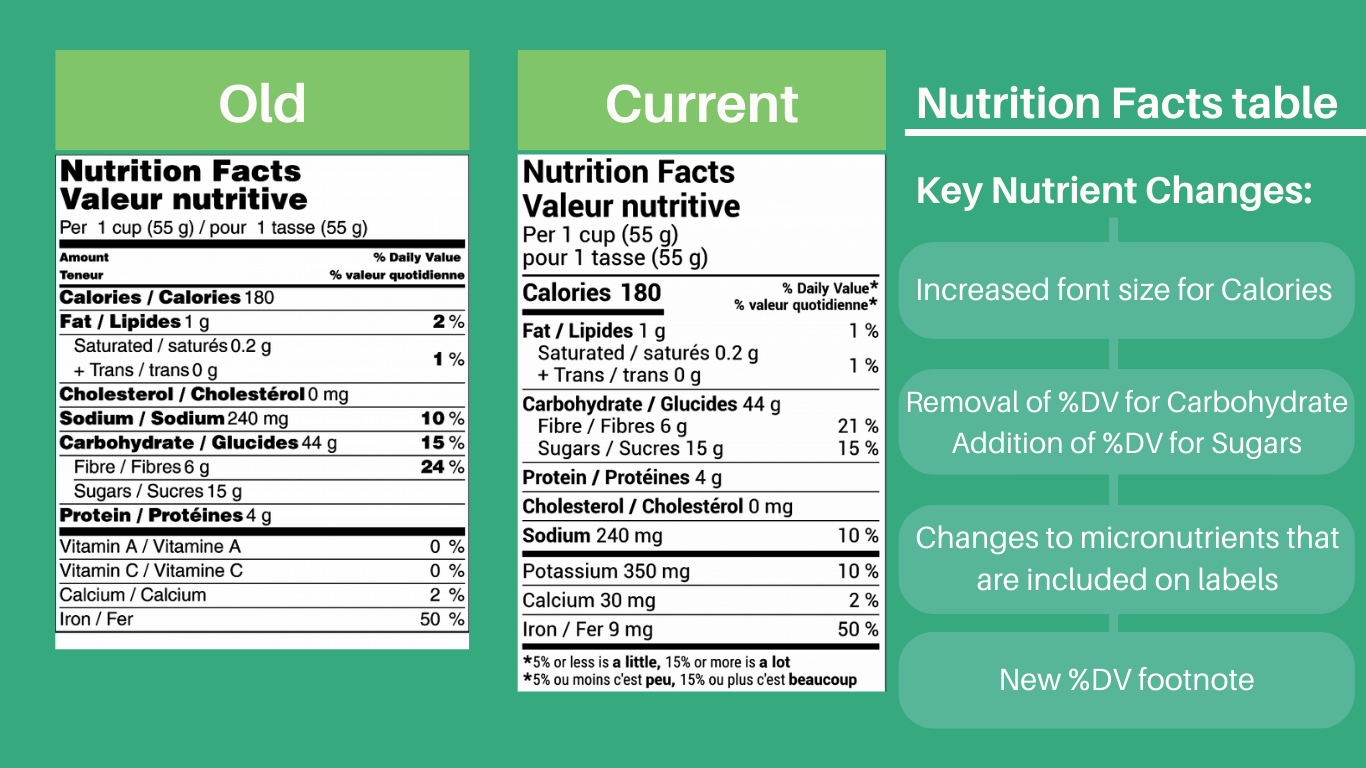
For more on what 100 g of total sugars can look like as part of a day’s worth of eating, view our resource “The Sweet Spot Challenge: A Compilation of Daily Menus Based on the 100 gram Daily Value for Sugars”.
Sugars in the Ingredient List
All sugars-based ingredients are grouped together in brackets following the term “Sugars” in the List of Ingredients (3). This includes functional substitutes that act as sweetening agents such as fruit juice concentrate and maltodextrin. This makes it easier for consumers to identify all sources of added sugars in a food or beverage. The placement of Sugars within the ingredient list depends on the total weight of all the sugars-based ingredients combined.
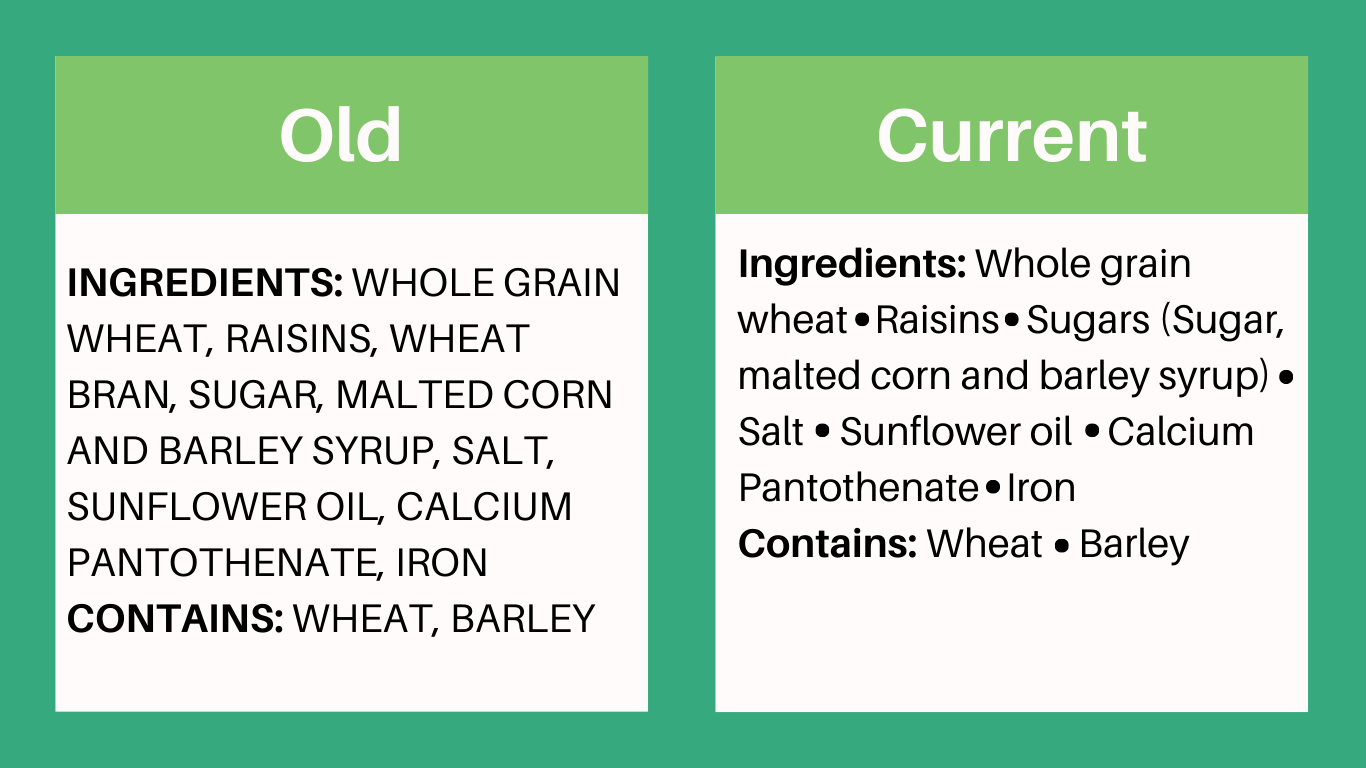
DID YOU KNOW?Unlike in the Nutrition Facts table, the term “Sugars” in the ingredient list includes only sugars-based ingredients (all added sugars and functional substitutes such as fruit juice concentrate and maltodextrin), but not sugars naturally occurring in fruits, vegetables, and dairy sources. |
Some of the common types of sugars you may find in the ingredient listing include:
| Sources | Sugar cane/beet sources | Corn sources | Other sources |
|---|---|---|---|
| Types |
Sugar Brown sugar, golden sugar Icing sugar Invert sugar Golden syrup Turbinado sugar, demerara sugar Molasses, fancy molasses |
Glucose/fructose (high fructose corn syrup) Corn syrup Corn syrup solids Dextrose Glucose High maltose corn syrup |
Agave syrup Coconut sugar Date sugar Fruit juice concentrate Honey Maple syrup Rice syrup Maltodextrin (without fibre) |
*Sugars ingredients do not include natural or artificial high-intensity sweeteners, sugar alcohols, or polydextrose.
Below are a few examples of how the grouping of sugars may give consumers better information about the sugars-based ingredients, by weight, in different food products.
| Food Product Example and Ingredient List | Comments |
|---|---|
|
Bran cereal with raisins Ingredients: Whole grain wheat • Raisins • Sugars (Sugar, malted corn and barley syrup) • Salt • Sunflower oil • Calcium • IronHuile |
|
|
Ingredients: Water • Sugars (concentrated white grape juice, strawberry puree, concentrated raspberry juice, concentrated blackberry juice) • White wine vinegar • Canola oil • Dijon mustard (water, mustard seeds, vinegar, salt, turmeric) • Salt • Concentrated lemon juice • Poppy seeds • Spices • Xanthan gum |
|
.png)
 Fruit-berry salad dressing
 Sugars-Related Nutrient Content Claims
Nutrient content claims are statements that highlight or describe the amount of a nutrient in a food (3, 4). There are six nutrient content claims related to sugars permitted in Canada, including a new "low in sugars" claim.
| Sugars – Related Claims | Regulations |
|---|---|
| "sugar-free" |
|
|
*NEW* "low in sugars" |
|
| "reduced in sugar" |
|
| "lower in sugar" |
|
| "no added sugar" |
|
| "unsweetened" |
|
*Note: Only the terms and wording outlined in the Food and Drug Regulations can be used to make a claim.
** “Similar reference food” means a food of the same type as the food to which is it compared and that has not been processed, formulated, reformulated, or otherwise modified in a manner that increases or decreases either the energy value, or the amount of a nutrient that is the subject of the comparison.
Note: For foods that display a “high in sugars” front-of-package symbol,
Are "reduced in sugar" or "no sugar added" products a better choice?
Because sugar plays a variety of roles in food products - from sweetness to adding bulk, colour, mouthfeel, and texture - other ingredients, such as sweeteners, starch-based thickeners, and fat, are often used to replace these functions. According to recent publications, products reformulated to be lower in sugars are not consistently lower in energy, due to an increase in starch or other ingredients used to replace sugar's functionality (2, 6-7). In addition, the reformulated product may have longer ingredient lists, have higher glycemic indexes due to the use of starch-based ingredients, may need additional warning statements on the label (e.g. aspartame), and may cost more.
This example compares a regular pre-packaged chocolate chip cookie to a "no sugar added" version:
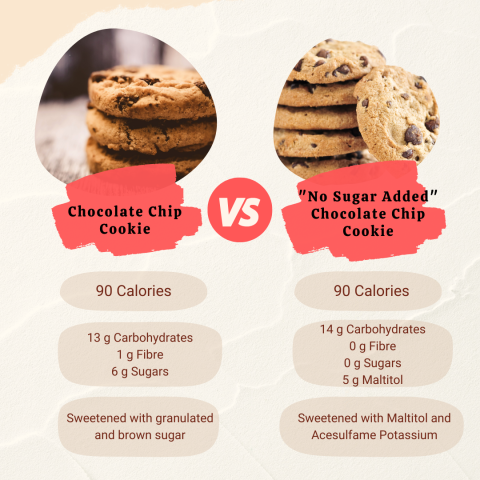
• Calories per cookie are exactly the same.
• Carbohydrates are higher in the “no sugar added” cookie.
• The "no added sugar" cookie contains 9 grams of starch per serving compared to 6 grams in the original recipe.
• Sugar was replaced with maltitol, a sugar alcohol, and acesulfame potassium, a non-caloric artificial sweetener
• The ingredient list and Nutrition Facts table for these and other reformulated products, will identify any changes in composition and nutritional value. This allows consumers to compare these products for carbohydrate and calorie information.
For more information, additional resources include:
- Infographic - Learning about Sugars Labelling: New Nutrition Information
- Infographic – Types of Sugars and Sweeteners
- Factsheet – Frequently Asked Questions: Functional Roles of Sugar
- Research publication - Wang, YF, et al. Disconnection between sugars reduction and calorie reduction in baked goods and breakfast cereals with sugars-related nutrient content claims in the Canadian marketplace. Front Nutr. 2025; doi: 10.3389/fnut.2025.1539695
- CSI research poster - Bakery products (presented at Canadian Nutrition Society 2023 Annual Conference)
- CSI research poster - Breakfast Cereals (presented at Dietitians of Canada 2023 National Conference)
- The Sweet Spot Challenge: A Compilation of Daily Menus Based on the 100 gram Daily Value for Sugars
- Video - “Is Sugar Hidden in Foods?” featuring dietitian Christy Brissette
- Health Canada – Front-of-Package Labelling Symbol
- Health Canada – Specific Nutrient Content Claim Requirements
- Health Canada – Criteria for the Nutrient Content Claim No Added Sugars
- Health Canada – List of Permitted Sweeteners
- Health Canada Nutrition Labelling Online Course
Relevant CSI news items include:
- March 2025 - New Study – Lack of Calorie Reduction in Baked Goods and Breakfast Cereals with Sugars Claims in Canada
- July 2023 - Lack of Calorie Reduction in Breakfast Cereals and Bakery Products with Sugars Claims in Canada
- August 2022 - Reading Food Labels: New Changes to Sugars-Related Claims
- May 2022 - Reading Food Labels: New Information on Sugars
- March 2017 - Recent Research on Front-of-Package Labels
References
- Health Canada. Front-of-package nutrition symbol labelling guide for industry [Internet]. Government of Canada; 2025 Sep 3 [cited 2026 Mar 6].
- Wang, YF, Marsden S, DiAngelo C, Clarke A, Chung A, Yu J, Fan Z, Cooper J, Kitts D. Disconnection between sugars reduction and calorie reduction in baked goods and breakfast cereals with sugars-related nutrient content claims in the Canadian marketplace. Front Nutr. 2025; doi: 10.3389/fnut.2025.1539695
- Health Canada. Nutrition labelling: Overview [Internet]. Government of Canada; 2024 Jul 5 [2026 Mar 5].
- Department of Justice Canada. Food and Drug Regulations [Internet]. Government of Canada; 2024 Feb 16 [cited 2024 Feb 21].
- Canadian Food Inspection Agency. Food labelling for industry [Internet]. Government of Canada; 2025 Jan 15 [cited 2026 Mar 6].
- Bernstein J, Christoforou AK, Weippert M, L'Abbé MR. Reformulation of sugar contents in Canadian prepackaged foods and beverages between 2013 and 2017 and resultant changes in nutritional composition of products with sugar reductions. Public Health Nutr. 2020;23(16), 2870-78.
- Vergeer L, Ahmed M, Vanderlee L, Mulligan C, Weippert M, Franco-Arellano B, Dickinson K, Bernstein JT, Labonte ME, L'Abbé MR. The relationship between voluntary product (re)formulation commitments and changes in the nutritional quality of products offered by the top packaged food and beverage companies in Canada from 2013 to 2017. BMC Public Health. 2022;22(271).


